Moscow House
Good Morning, Midnight (Reginald Hill Edition)Moscow House is the Maciver family home where the deaths of Palinurus Maciver Senior and his son, Palinurus Maciver Junior, are separated by ten years but linked by the same study. The house’s significance lies not only in the events that occur there: its rooms preserve a family’s competing memories, while its doors, shutters, and traces of earlier use become part of the police investigation. Each return makes the building less a private refuge than a space in which the past remains active.
Setting and Identity
The approach to Moscow House establishes an image of an old property whose former form has partly disappeared. The drive runs beneath plane trees between two stone pillars. Stumps at the tops of the pillars suggest that they once carried some ornamental or heraldic feature, and the substantial hinges on one pillar remain after the ornate metal gate itself has vanished. The house’s name is still legible, deeply cut into the other pillar despite the lichen. The entrance therefore presents both continuity and loss: the family name survives in stone, while visible signs of the property’s former status and enclosure have been removed.
The house can appear entirely deserted. On one visit, its darkness and shuttered windows confirm that no one is expected to be there. At another point it is lit within, but the shutters and curtains keep the light contained; only the open front door allows a little to escape. These changes do not establish a permanent condition so much as make the building’s accessibility uncertain. It can be closed off and apparently empty, then illuminated and occupied, with the entrance itself becoming the threshold between concealment and disclosure.
The house is identified as the Maciver family home and is closely tied to the family’s history. Helen Dunn recalls it as the place where she was born, where her mother died, and where her father and brother later died. Her account makes the house a container for several distinct losses, not simply the setting of one notorious incident. The family’s memories attach to particular rooms and events, so that being in the house can mean confronting a personal past as well as entering a location under investigation.
The Study and the Earlier Death
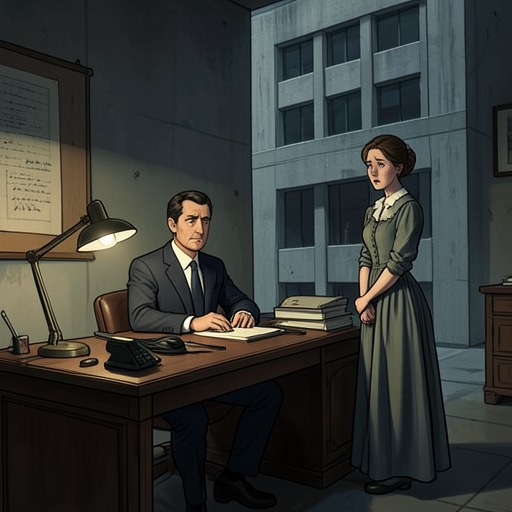
The study is the house’s central room in the novel’s history. Ten years before the later investigation, Palinurus Maciver Senior died there by suicide. His son found him after returning from Cambridge, and the death became a defining point in the family’s experience of the house. The study consequently carries an accumulated meaning: it is where a father died, where his son would also die, and where later investigators must test whether familiar appearances can be trusted.
The room’s physical condition gives the earlier event a continuing presence. During the later inquiry, the shutters are opened for examination, but their catches are almost fused by corrosion and the sash windows are stiff from long disuse. The police consider whether the windows may have remained closed since Palinurus Maciver Senior’s death. They leave them open to disperse the residue of smoke, cordite, and death. This detail makes the room’s long closure more than an atmospheric impression: the building’s fittings provide material evidence of how little the space may have been disturbed.
For Helen Dunn, entering the house means returning to a place inseparable from bereavement. She presents the prospect of telling her story there as a way of raising the past rather than avoiding it. The house thus frames recollection as an encounter with a real location: family history is not recalled at a distance but spoken from within the home where those events occurred.
Family Ownership and Estrangement
Moscow House’s status as a family property becomes a source of conflict after the death of Palinurus Maciver Senior. His will leaves the house to his three children. Kay Kafka, as guardian of Helen Dunn, has authority to act for her, and proposes that the property be put on the market. Helen’s sibling Cressida Maciver recalls that she herself might have accepted the proposal, since the house felt disturbing after their father’s death. Palinurus Maciver Junior, however, refuses to agree. He regards keeping the house within the family as a boundary he will not concede, even though he believes he has lost other disputes with Kay Kafka.
The disagreement reveals that the house has unequal meanings for its heirs. For Cressida Maciver, its unnerving associations make a sale acceptable; for her brother, preserving it becomes an act of resistance and a claim about family belonging. The inheritance is therefore not merely financial. Whether the house should remain with the family becomes a decision about who controls the shared past and whether that past should continue to be embodied in a place.
The family firm’s financial difficulties form part of the wider background to this history. Palinurus Maciver Senior faced a choice between accepting an offer from the American company Ashur-Proffitt or seeing more workers laid off. The business became associated with the acquiring company, and he received money and a position on its board that was described as largely symbolic. This account situates the family home within a period of economic pressure and change, though the evidence presents the house and the firm as related parts of the family’s circumstances rather than equating the business dispute with the later deaths.
Police Inquiry and Repeated Access
The house first enters the police narrative as a place whose keyholder cannot be found. The keyholder is identified as Palinurus Maciver, while his wife reports that she does not know where he is; he has also missed an appointment. When officers arrive, an investigator forces open a door, and light from the landing spills into the room beyond. The practical problem of gaining entry quickly becomes part of the scene: the house is both a residence with an absent owner and a space the police must enter to understand what has happened.
A later visit begins with attention to the house’s surroundings and moves upstairs, where investigators examine the study. Their work connects present observations with the earlier death: the room’s sealed or neglected condition, its shutters, and the evidence inside it all require interpretation. The house is not treated as a neutral backdrop. Its rooms and objects can support or weaken explanations, while the passage of time complicates what investigators can infer from them.
The inquiry also returns to material removed from or examined in connection with the house. A coil of rope shows no sign of having been used to hang or whip anyone. An ice axe, dusty and rusted, carries faint traces of blood judged too old to relate to the current investigation. The axe had been displayed on the wall beside a portrait of Palinurus Maciver Senior in outdoor clothing. Its later appearance as a bloodstained object near Palinurus Maciver Junior’s body gives the house’s stored objects a second, more immediate significance. The distinction between old traces and present evidence is essential: the object belongs to the history of the house, but not every mark on it belongs to the crime now being investigated.
Recurrence and Narrative Significance
Moscow House’s meaning changes with each return. It is at once the home where a family lived, the scene of two deaths, an inherited property contested among siblings, and a location whose contents must be reassessed by investigators. These roles overlap without resolving into a single account of what the house means to every character. The same building that one family member finds disturbing is the place another insists should remain in family hands; what is a home in one recollection becomes a crime scene in another.
The recurrence of the study sharpens this pattern. Palinurus Maciver Senior died there; later, Kay Kafka walks upstairs and enters the room where both her husband and stepson died. Investigators examine its windows and objects, and the eventual discovery of Palinurus Maciver Junior’s body there makes the earlier history newly consequential. The study’s repeated use links generations while preserving a crucial difference between their deaths: resemblance invites suspicion, but it does not by itself prove that the same explanation applies.
The house also becomes part of a proposed staging of the later death. Investigators consider suicide as the obvious appearance to present, with the study’s shotgun cabinet supplying a plausible weapon and the locked room helping make the scene look self-contained. The discussion concerns how a death might be made to seem convincing, not a settled conclusion that the house itself explains what happened. In this way, Moscow House embodies the novel’s tension between physical evidence and interpretation: doors can be forced, windows examined, and objects tested, but the past gathered in the rooms does not automatically yield an uncomplicated truth.